Trim Suppliers: The Unsung Heroes of the Fashion Industry

- Bernice
- October 9, 2026
- clothing manufacturers, Fashion Business, Independent Designers, UK Fashion Industry
When we think about fashion, we naturally think about fabrics, silhouettes, colours and prints. But behind almost every finished garment is another world of materials that is just as important: trims.
From the zipper on a jacket and the buttons on a shirt to the label inside a neckline and the elastic in a waistband, trims are the details that make a garment functional, distinctive and complete.
For fashion brands, manufacturers and retailers, working with the right trim supplier is therefore far more than simply sourcing buttons or ribbons. A good trim supplier can become an essential partner in product development, helping brands turn a design concept into a commercially viable, high-quality garment.
What are garment trims?
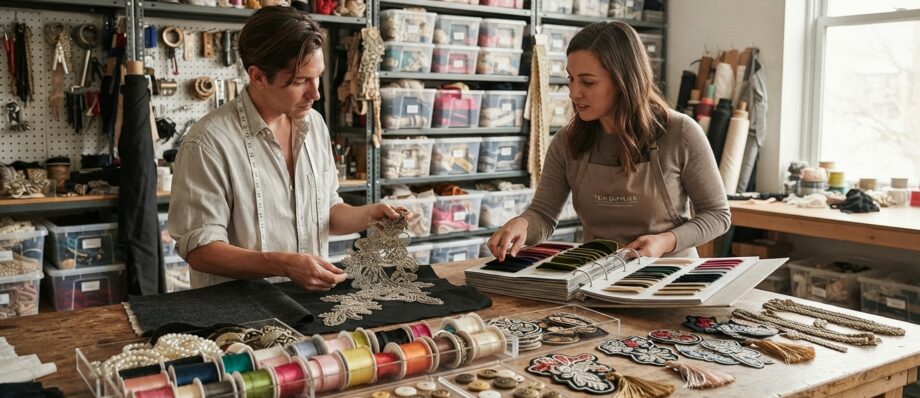
In simple terms, garment trims are the components used in clothing production other than the main fabric. They can be functional, decorative, structural or related to branding and presentation. Trims can range from relatively small components such as sewing thread and labels to highly visible design details such as lace, fringing, embroidery, sequins and decorative hardware.
They can also be divided broadly into visible and invisible trims. Visible trims contribute directly to the appearance of a garment, while invisible trims provide structure, support or functionality behind the scenes.
What does a trim supplier actually supply?
A specialist trim supplier can provide an enormous variety of components, depending on its area of expertise.
Some suppliers concentrate on a particular category, such as zips, buttons or labels. Others offer a much broader service covering everything from interlinings and elastics to decorative embellishment and packaging.
A typical fashion trims supplier may supply:
- Fastenings such as zips, buttons, snaps and hooks
- Labels and branding components
- Ribbons, tapes and cords
- Elastics and ribbing
- Lace and decorative edging
- Piping and binding
- Buckles, eyelets and other hardware
- Embroidery, patches and appliqué
- Beads, sequins and other embellishments
- Interlinings and structural components
- Sewing threads
- Packaging and garment presentation components
Some suppliers also offer product development, sampling, colour matching, custom manufacturing and sourcing services, allowing a brand to develop trims specifically for a collection rather than selecting entirely off-the-shelf products.
25 types of fashion trims
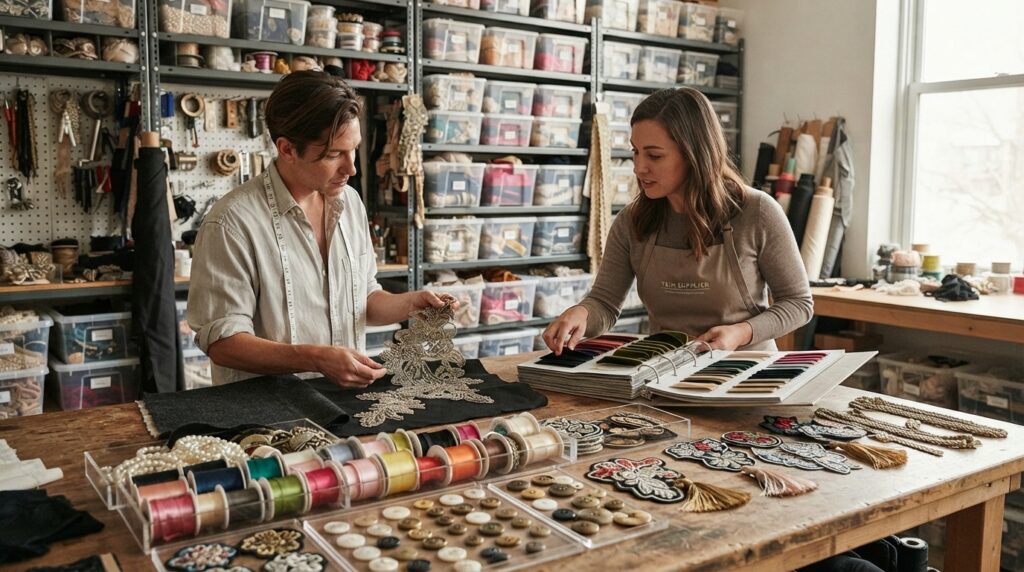
The world of trims is huge, but here are 25 of the most important categories used across fashion and apparel.
1. Buttons
Perhaps one of the most recognisable garment trims, buttons are used for both fastening and decoration.
They can be produced from materials including resin, metal, wood, corozo, shell and other natural or synthetic materials. A button can be understated and functional or become a major design feature in its own right.
2. Zips
Zippers are essential fastening components used across everything from jeans and trousers to dresses, jackets, bags and outerwear.
Options include metal, nylon, resin, invisible and waterproof zips, with different constructions suited to different garments.
3. Snaps and press studs
Snaps provide quick and convenient fastening and are particularly common in childrenswear, casualwear, outerwear, workwear and denim.
They can also be customised in different finishes and colours to complement a garment.
4. Hooks and eyes
Small but highly useful, hooks and eyes provide discreet fastening and are particularly common in lingerie, tailoring, eveningwear and fitted garments.
5. Elastic
Elastic provides stretch, comfort and recovery. It is used in waistbands, cuffs, lingerie, sportswear, underwear and many other applications.
Elastic can be woven, knitted or braided, with different widths and performance characteristics.
6. Ribbons
Ribbons can be decorative or functional and come in materials such as satin, grosgrain, velvet and jacquard.
They can be used as ties, waist details, straps, bows, edging or branding details.
7. Tapes
Tapes are used extensively for reinforcement, binding, decoration and construction. Examples include twill tape, herringbone tape, cotton tape and jacquard tape.
8. Lace
Lace adds texture, femininity and intricate detail to garments. It is particularly popular in lingerie, bridalwear, occasionwear and womenswear, although modern applications span almost every fashion category.
9. Braid
Braids can be used to decorate seams, edges, collars, cuffs and accessories. They range from simple woven constructions to elaborate decorative designs.
10. Piping
Piping is used along seams and edges to create definition and structure.
It can be subtle and tonal or deliberately contrasting, making it particularly useful for adding a premium or tailored appearance.
11. Bias binding
Bias binding is used to neatly finish raw edges and can also become a visible design feature.
It is widely used around necklines, armholes, hems and internal garment construction.
12. Drawcords
Drawcords are especially important in casualwear, sportswear and outerwear. They allow garments to be adjusted at hoods, waistbands and hems.
Cord can be finished with branded or decorative cord ends for an additional design detail.
13. Cord and rope
Cord can be used for ties, straps, decorative details and fastening systems. Different fibres, constructions and thicknesses allow designers to achieve anything from delicate to industrial-looking finishes.
14. Labels
Labels are fundamental to both branding and garment information.
They can include woven brand labels, printed labels, size labels, care labels and composition labels. As well as communicating essential information, a well-designed label can contribute significantly to a garment’s perceived quality.
15. Patches and badges
Embroidered, woven and printed patches can be used for branding, decoration or storytelling.
They are particularly popular in streetwear, denim, childrenswear, uniforms and casual fashion.
16. Embroidery
Embroidery can be incorporated into garments as a decorative feature or supplied as a separate embroidered trim, motif or tape.
It can transform a simple garment into something much more distinctive.
17. Appliqué
Appliqué involves attaching a separate fabric or material shape to the garment to create a decorative design.
It can be used alongside embroidery, sequins, beads and other techniques.
18. Sequins
Sequins provide shine, movement and visual impact.
They are widely used in occasionwear, eveningwear, performance clothing and statement fashion, either individually or as part of larger embellished trims.
19. Beads
Beaded trims can add texture, weight and luxury. They range from delicate beadwork to heavily embellished borders and motifs.
20. Fringing
Fringe is a particularly effective way to introduce movement and texture.
It can be made from yarn, chainette, ribbon, beads or other materials and is frequently used on eveningwear, accessories, outerwear and statement pieces.
21. Tassels
Tassels are decorative elements made from gathered or knotted threads, cords or other materials.
They can be used on garments, accessories and belts and are especially effective as a fashion-forward finishing detail.
22. Buckles
Buckles combine function with strong visual appeal. They can be used on belts, straps, bags, footwear and garments.
Metal, resin and other materials can be developed into everything from simple functional hardware to highly distinctive branded components.
23. Eyelets and rivets
Eyelets reinforce holes while adding a finished appearance, particularly when used with drawcords or lacing.
Rivets are particularly associated with denim and workwear and can provide both reinforcement and branding.
24. Interlinings and structural trims
Not every important trim is visible.
Interlinings, shoulder pads, fusing and other structural components help garments maintain their shape, improve fit and create the desired silhouette. They are particularly important in tailoring, outerwear and structured fashion.
25. Sewing thread
It may be one of the least noticeable components, but sewing thread is fundamental to garment construction.
The correct thread needs to provide the appropriate strength, appearance, colour and performance for the garment. Although it represents a relatively small part of the overall product, thread has a significant influence on the durability and appearance of the finished garment.
Why are trim suppliers so integral to fashion?
They turn designs into products
A designer may sketch a jacket with a statement zip, oversized buttons and branded hardware. A trim supplier helps turn those ideas into physical components that can actually be manufactured and used at scale.
This development process can involve selecting materials, creating samples, matching colours, testing components and refining specifications.
They influence the quality of the finished garment
Trims may be small, but they can have a disproportionate effect on how a garment looks and performs.
A poorly functioning zip, weak snap, uncomfortable elastic or badly finished label can immediately make an otherwise excellent garment feel cheap.
Conversely, a beautifully made button, high-quality zip or carefully developed branded trim can elevate the entire product.
They help define brand identity
Trims are increasingly used as a form of brand signature.
A distinctive metal button, branded zip pull, woven label, jacquard ribbon or custom hardware can make a garment recognisable without relying on a large logo.
For many brands, these details become part of their visual language.
They support consistency across production
Once a garment moves from development into bulk production, consistency becomes critical.
Trim suppliers need to reproduce approved colours, dimensions, finishes and specifications across production runs. This is particularly important for brands producing across multiple factories or sourcing internationally.
They contribute to cost control
Trims are also an important part of garment costing.
A designer may initially select a particular button, zip or embellishment without considering its minimum order quantity, manufacturing process or unit cost. An experienced supplier can help identify alternatives that achieve a similar aesthetic while making commercial sense.
They help brands respond to trends
Fashion moves quickly, and trim suppliers are often close to the latest developments in materials, finishes, colours and decorative techniques.
From new metal finishes to recycled materials, statement hardware, embellished tapes and innovative fastenings, suppliers can introduce brands to possibilities they may not otherwise encounter.
They increasingly support sustainability
Sustainability is another area where trim suppliers have an important role to play.
Brands are increasingly looking for recycled, recyclable, certified and lower-impact materials, including recycled polyester, recycled metals and more responsibly sourced natural materials.
The choice of trim can therefore form part of a garment’s wider sustainability strategy rather than being treated as an afterthought.
Choosing the right trim supplier
For fashion brands, choosing a trim supplier should be about more than price.
Important considerations include:
Quality: Can the supplier consistently meet the required specification?
Development capability: Can they create bespoke trims or adapt existing designs?
Sampling: Can they provide samples quickly enough to support product development?
Colour matching: Can they accurately match a brand’s colour standards?
Capacity: Can they support both small development orders and larger production quantities?
Reliability: Can they maintain consistent quality and delivery schedules?
Compliance: Can they provide the required testing, certifications and documentation?
Sustainability: Can they offer lower-impact materials and transparent sourcing information?
Communication: Can they work effectively with designers, product developers, buyers and factories?
A strong supplier relationship can ultimately save time, reduce production problems and make the development process much smoother.
The small details that make a big difference
Fashion is often described as an industry driven by big ideas: the collection, the silhouette, the fabric, the campaign.
But the success of a finished garment often comes down to the details.
A perfectly chosen button. A smooth-running zip. A beautifully woven label. A carefully matched ribbon. A high-quality piece of hardware.
These details may be small, but together they influence how a garment looks, feels, functions and is perceived by the customer.
That is why trim suppliers are such an integral part of the fashion supply chain. They aren’t simply supplying the finishing touches — they are helping brands turn creative ideas into finished products that can be manufactured, sold and remembered.