Creative Pattern Cutting: Where Fashion Design Meets Innovation

- Bernice
- October 10, 2026
- clothing manufacturers, Independent Designers, UK Fashion Industry
Fashion begins with an idea, but transforming that idea into a three-dimensional garment requires skill, precision and creativity. One of the most important stages in this process is creative pattern cutting.
While pattern cutting is often associated with technical accuracy and construction, creative pattern cutting goes much further. It gives designers the freedom to experiment with shape, proportion, volume and movement, helping turn an initial concept into something distinctive and unexpected.
What is creative pattern cutting?
Pattern cutting is the process of creating the individual pieces needed to construct a garment. These pieces are carefully developed so that they can be cut from fabric and assembled to create a finished three-dimensional form.
Creative pattern cutting takes this technical process and approaches it as a design tool.
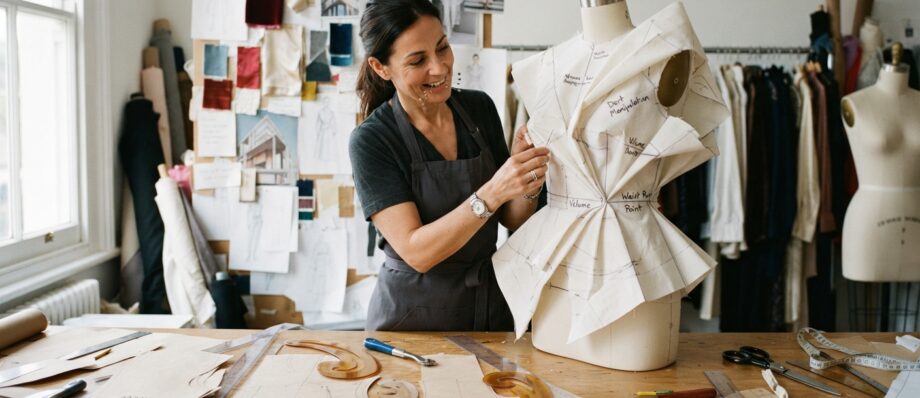
Rather than simply translating an existing sketch into a pattern, the pattern cutter works alongside the designer to explore what is possible. Darts can be manipulated, seams can be repositioned, volumes can be exaggerated and traditional construction methods can be challenged.
The result can be garments with unusual silhouettes, sculptural forms, unexpected proportions and innovative construction details.
The relationship between design and pattern cutting
The most successful creative pattern cutting often happens when the designer and pattern cutter collaborate from the beginning.
A fashion sketch might communicate the overall vision, but it cannot always show exactly how a garment should be constructed. This is where the expertise of a skilled pattern cutter becomes invaluable.
They can assess a design and determine:
- How the garment can be constructed
- Where seams and panels should sit
- How volume can be created
- How the garment will move on the body
- Where shaping and support are required
- Which construction techniques will work best
- How the design can be translated into a commercially viable product
In this sense, pattern cutting isn’t simply a technical step after design. It can become part of the creative process itself.
Exploring shape and silhouette
One of the most exciting aspects of creative pattern cutting is the opportunity to experiment with silhouette.
Traditional garments often follow familiar principles of shaping and construction. Creative pattern cutting allows designers to question those conventions.
A simple dress can become architectural through carefully controlled volume. A jacket can be transformed through unconventional seam placement. A sleeve can extend, twist or fold in unexpected ways.
These experiments can create garments that feel sculptural while still functioning as wearable clothing.
Draping and three-dimensional development
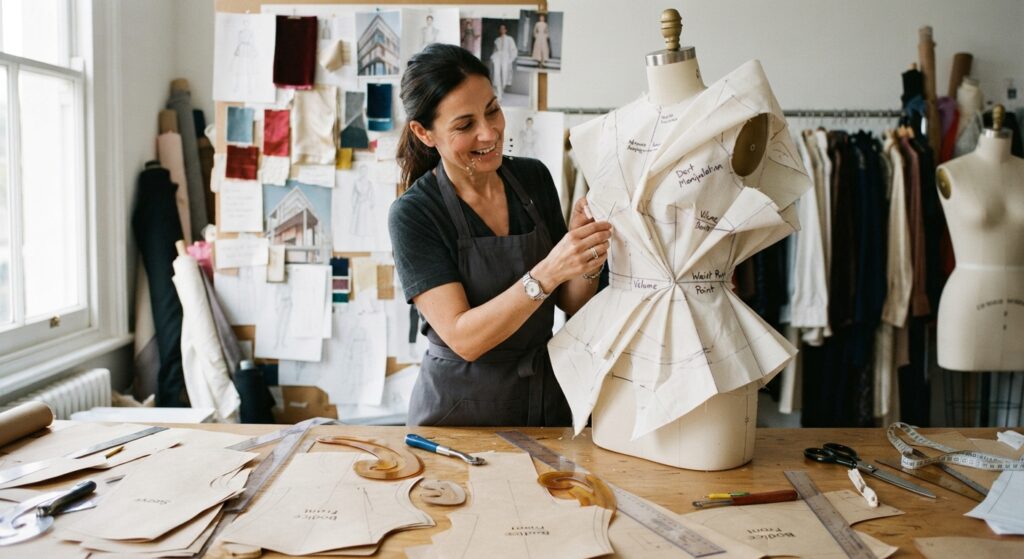
Creative pattern cutting is closely connected to draping, where fabric is manipulated directly on a mannequin or dress form.
Instead of beginning entirely with a flat paper pattern, the designer or pattern cutter can pin, fold, twist and shape fabric on the body. This makes it possible to explore how a garment behaves in three dimensions.
Once the desired shape has been developed, it can be transferred into a flat pattern and refined.
Draping can be particularly useful when developing complex silhouettes because it allows the designer to respond directly to the behaviour of the fabric and the shape of the body.
Pattern cutting as a problem-solving tool
Creativity doesn’t mean abandoning technical precision.
In fact, some of the most innovative garments require an extremely strong understanding of construction.
A pattern cutter needs to understand how different pieces will connect, where tension will occur and how the garment will behave when it is worn.
They must also consider practical questions such as seam allowances, grainlines, balance, ease and fabric properties.
This combination of creative thinking and technical knowledge is what makes pattern cutting such a powerful part of fashion development.
Experimenting with fabric
Fabric choice and pattern cutting are intrinsically connected.
Different fabrics behave in very different ways. A structured wool might hold an architectural shape, while a lightweight silk could create fluid movement. Stretch fabrics require different considerations again.
Creative pattern cutting allows designers to explore these characteristics rather than simply working around them.
Bias cutting, for example, can create fluidity and drape. Pleating can introduce volume and texture, while gathering can create fullness and movement.
Understanding the relationship between fabric and pattern is therefore essential when developing an innovative garment.
The importance of fashion pattern cutting
Within the wider fashion industry, fashion pattern cutting is an essential link between creative concept and finished product.
A beautiful design needs to work not only visually but physically. It needs to fit the body, move appropriately and be capable of being constructed.
Pattern cutting provides the technical framework that makes this possible.
For emerging designers, developing an understanding of pattern cutting can also open up new creative possibilities. Rather than designing a silhouette and relying entirely on someone else to determine how it will be made, designers can use pattern development as part of their own creative experimentation.
From toile to finished garment
Creative ideas rarely arrive perfectly formed on the first attempt.
Pattern cutters commonly develop prototypes or toiles to test a garment before it is produced in its final fabric.
A toile allows the team to assess:
- Fit and proportion
- Silhouette
- Volume
- Construction
- Movement
- Seam placement
- Overall balance
The pattern can then be adjusted and tested again.
This process of making, assessing and refining is a fundamental part of creative pattern development.
Challenging traditional techniques
Some of fashion’s most memorable designs have emerged from questioning conventional construction.
Creative pattern cutting can involve experimenting with:
- Asymmetrical construction
- Unusual seam lines
- Zero-waste layouts
- Transformable garments
- Oversized or exaggerated proportions
- Modular pattern pieces
- Draped and folded forms
- Deconstructed construction
- Innovative closures
- Sculptural silhouettes
These techniques can give designers new ways to communicate an idea or create a distinctive identity.
Creative pattern cutting and sustainability
Pattern cutting can also play an important role in creating more responsible fashion.
One increasingly important approach is zero-waste pattern cutting, where pattern pieces are designed to use as much of the available fabric as possible, minimising cutting waste.
Instead of designing the garment first and accepting the resulting fabric waste, designers can consider the entire fabric width and pattern layout as part of the design process.
Creative thinking can therefore contribute not only to aesthetic innovation but also to more efficient approaches to garment production.
Why creative pattern cutting matters
At its best, creative pattern cutting sits somewhere between design, engineering and craftsmanship.
It allows an idea to evolve through experimentation and gives designers the opportunity to discover shapes that may not have been apparent in an initial sketch.
The pattern cutter isn’t simply following instructions. They are interpreting, problem-solving and often contributing ideas of their own.
This collaboration can be particularly valuable in contemporary fashion, where originality and distinctive silhouettes are increasingly important.
Turning ideas into garments
The journey from concept to finished garment involves many stages, but creative pattern cutting remains one of the points where imagination and technical skill meet most directly.
It gives designers the tools to explore shape, challenge convention and develop garments that are not only visually interesting but also considered in their construction.
Whether through traditional flat pattern cutting, draping, experimental construction or zero-waste approaches, pattern cutting continues to be an essential part of fashion design.
Ultimately, creative pattern cutting is about more than creating a template for a garment. It is about discovering what a garment can become.