
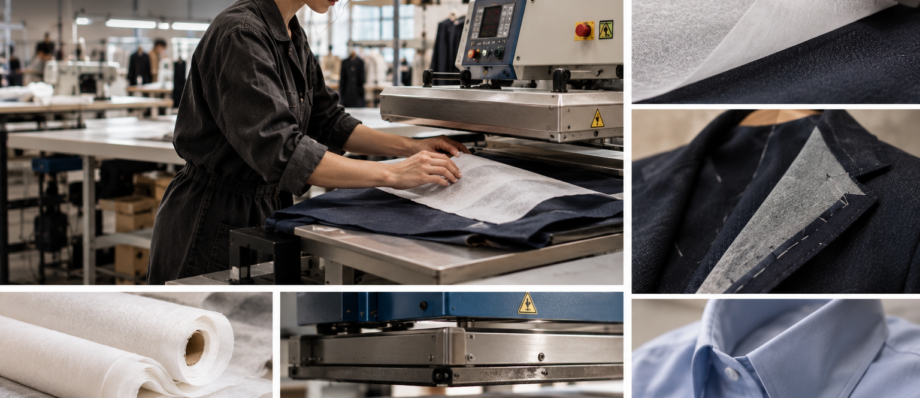
What Is Fusing in Sewing?

- Bernice
- October 11, 2026
- clothing manufacturers, Independent Designers, UK Fashion Industry
If you’ve ever looked inside a beautifully made jacket, coat, shirt or dress and wondered how the fabric keeps its shape, there’s a good chance fusing is part of the answer.
Fusing is an important process in garment manufacturing and sewing. It is used to give fabric additional structure, stability, support and shape, helping garments look better and perform better when worn.
From collars and cuffs to waistbands, jackets and coats, fusible materials can be found in all sorts of clothing — often hidden between layers of fabric.
But what exactly is fusing, how does it work, and why is it so important in clothing manufacturing?
What Does Fusing Mean in Sewing?
In sewing, fusing is the process of bonding two layers of material together using heat, pressure and adhesive.
The material being attached is usually called fusible interfacing. One side of the interfacing has a heat-activated adhesive, commonly applied as tiny dots or a coating.
When heat and pressure are applied, the adhesive melts and bonds the interfacing to the main fabric.
Once it cools, the two materials become one supported layer.
Unlike sewing two pieces of fabric together, fusing doesn’t normally involve stitching. Instead, the adhesive creates the bond.
This makes it a quick and effective way to reinforce areas of a garment without adding visible seams or stitches.
What Is Fusible Interfacing?
Interfacing is a material placed between or behind layers of fabric to give them additional support.
There are two main types:
Fusible interfacing is attached using heat and pressure.
Sew-in interfacing is attached using stitching rather than adhesive.
Fusible interfacing can be made from different fibres and materials, including woven, non-woven and knitted constructions.
The choice depends on the fabric and the result the manufacturer or designer wants to achieve.
For example, a lightweight fusible may be appropriate for a delicate blouse, while a much firmer interfacing might be used inside a tailored jacket.
Why Do We Use Fusing?
The main purpose of fusing is to control the behaviour of fabric.
Fabric can be soft, flexible or difficult to handle on its own. Adding an interfacing can make it more stable and easier to construct.
Fusing can provide:
- Structure – helping a garment hold its shape.
- Stability – preventing fabric from stretching or distorting.
- Support – strengthening areas that receive additional stress.
- Shape retention – helping collars, cuffs and waistbands maintain their form.
- Improved appearance – creating a cleaner and more professional finish.
- Ease of manufacture – making certain fabrics easier to cut and sew.
It is particularly important in garments where shape and construction are essential.
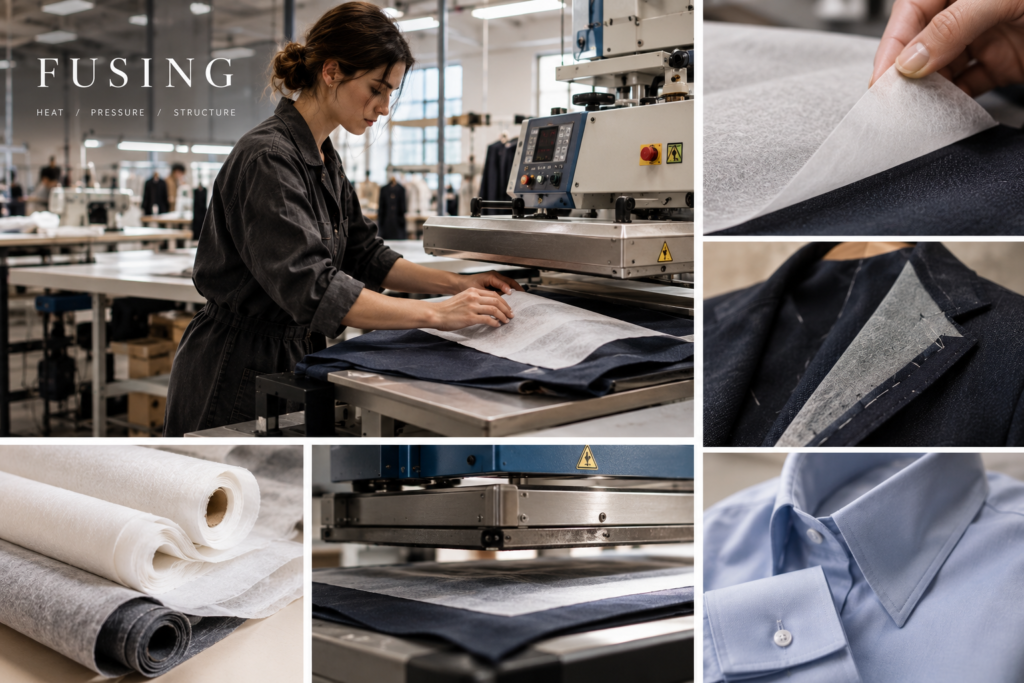
Where Is Fusing Used in Garments?
Fusing can be used in many different parts of a garment.
Collars
Shirt and jacket collars often use interfacing to give them structure.
Without support, a collar made from lightweight fabric might collapse or become difficult to shape.
The correct interfacing helps the collar sit neatly around the neckline while maintaining the desired appearance.
Cuffs
Cuffs can also be fused to add stability.
This is particularly common in shirts, blouses and tailored garments.
Fusing helps the cuff maintain its shape and gives it enough body to support buttons, buttonholes and other construction details.
Waistbands
A waistband needs to remain stable while also fitting comfortably around the body.
Interfacing can help prevent the waistband from stretching and becoming misshapen.
This is particularly useful in trousers, skirts and structured dresses.
Jackets and Coats
Tailored jackets and coats can contain significantly more internal support.
Different types of interfacings may be used throughout the garment, including in the front panels, lapels, collars, pockets and hems.
The objective is to create a garment that holds its shape while still having the appropriate amount of movement and flexibility.
Pockets
Fusing can also be used around pockets and openings where the fabric needs additional stability.
This helps prevent the fabric from stretching or becoming distorted during construction and wear.
How Does the Fusing Process Work?
Although the principle is simple, professional fusing requires careful control.
A typical process involves placing the fusible interfacing against the wrong side of the fabric, with the adhesive side facing the fabric.
Heat and pressure are then applied.
The heat activates the adhesive, while pressure helps it bond evenly to the fabric.
The materials are then allowed to cool so that the adhesive can set.
In a professional garment factory, this process may be carried out using a fusing press rather than a domestic iron.
A fusing press provides much greater control over temperature, pressure and application time.
This is particularly important when producing garments commercially because every piece needs to be consistent.
What Is a Fusing Press?
A fusing press is a specialist piece of garment manufacturing equipment designed to bond fusible materials to fabric.
There are different types of fusing equipment, ranging from smaller presses used for sampling and small production runs to large continuous fusing machines used in industrial manufacturing.
The machine controls key variables such as:
Temperature: How hot the surface becomes.
Pressure: How firmly the materials are pressed together.
Time: How long the materials are exposed to the heat and pressure.
These three factors are critical.
If the temperature is too low, the adhesive may not activate properly.
If it is too high, the fabric or adhesive can be damaged.
If there isn’t enough pressure or time, the bond may be weak or uneven.
This is why manufacturers normally follow the specifications provided by the interfacing supplier.
Why Does Fusing Sometimes Go Wrong?
Fusing might sound straightforward, but there are several things that can go wrong.
One common problem is bubbling or delamination, where the interfacing doesn’t bond properly to the fabric.
This can happen if the temperature, pressure or application time isn’t correct.
Another issue is strike-through, where adhesive becomes visible through the fabric.
This can be particularly problematic with lightweight or pale fabrics.
There can also be problems with shrinkage, colour changes, fabric distortion or an interfacing that is simply too stiff for the garment.
For this reason, manufacturers should always test the combination of fabric and interfacing before beginning production.
Testing Is Essential
One of the most important stages of professional fusing is testing.
Different fabrics react differently to heat and pressure.
A silk blouse, cotton shirt, wool jacket and synthetic sportswear garment may all require completely different fusing specifications.
A manufacturer will often create a small test piece before production begins.
This allows them to check:
- Does the interfacing bond correctly?
- Does the fabric change appearance?
- Is the finished fabric too stiff?
- Does the adhesive show through?
- Does the fabric shrink?
- Can the fused fabric still be sewn easily?
- Does the bond remain secure after washing or dry cleaning?
Testing helps prevent expensive production problems later.
Fusing in Clothing Manufacturing
Fusing becomes particularly important when moving from individual samples into commercial production.
A designer may select a beautiful fabric, but that fabric may behave very differently once interfacing is applied.
This is why experienced clothing manufacturers often work closely with pattern cutters, garment technologists and fabric suppliers when selecting the right combination.
For a manufacturer, the objective isn’t simply to make the fabric stiffer.
It’s about creating the right amount of support in the right place.
A collar might need to be firm.
A waistband may need stability but still require some flexibility.
A tailored jacket might require several different types of interfacing throughout the garment.
The choice of fusing therefore becomes part of the overall garment engineering.
Fusing vs Sewing
So, why use adhesive instead of simply sewing the interfacing into place?
There are several advantages.
Fusing can be quicker and can create a smooth, clean finish without additional stitching.
It can also prevent the interfacing from shifting inside the garment during construction.
However, fusible interfacing isn’t suitable for every fabric or garment.
Some fabrics can be sensitive to heat, while others may require the softer, more flexible finish provided by sew-in interfacing.
This is why professional manufacturers choose the method based on the garment rather than automatically using one technique.
Is Fusing the Same as Bonding?
The terms fusing and bonding are sometimes used interchangeably, but they can refer to slightly different manufacturing processes.
Fusing generally describes the use of heat-activated adhesive materials, particularly interfacing.
Bonding is a broader term that can describe joining materials using adhesives, heat or other technologies.
In modern clothing manufacturing, bonding can be used to create garments with minimal or even no conventional stitching.
This is particularly common in technical clothing, sportswear and performance garments.
Why Fusing Matters
Fusing might be hidden inside a garment, but it can have a huge impact on the finished product.
The right interfacing can transform a soft piece of fabric into a beautifully structured collar.
It can give a jacket its shape, keep a waistband stable and help a shirt maintain its crisp appearance.
The wrong interfacing, however, can have the opposite effect.
It can make a garment feel too stiff, cause bubbling, create visible marks or affect how the fabric moves.
For clothing manufacturers, fusing is therefore much more than simply sticking two fabrics together.
It’s a technical process that requires an understanding of fabric, adhesive, temperature, pressure and garment construction.
And although you might never see the fusing inside a finished garment, you can certainly see and feel the difference it makes.